Friday, March 22, 2013

Bullet Point Ethics as Policy Advice?


Bioethics as well as various specialties within the field (research ethics and public health ethics among them) is more often than not policy oriented. This is not terribly surprising, seeing that sound ethics aims at providing action guidance as well as action justification. It remains, of course, a bone of contention among ethicists and philosophers whether this can actually be achieved in the absence of final answers to fundamental meta-ethical questions. Let us leave this thorny issue aside for the moment.  A consensus seems to exist at least among bioethicists and others engaged in applied ethics that we can and should press ahead regardless of those intractable final answers and that we should utilize the tools of ethical analysis to address real-world problems.

Ever since Tom Beauchamp and James Childress hugely successful Principles of Biomedical Ethics entered the textbook market place principles have become a popular teaching tool in many a medical school. Among philosophers these principles have not been as successful as they are among teachers in medical schools, mostly because of concerns about their lack of action guidance and action justification.  Debates among bioethicists about the viability of the Georgetown Mantra will undoubtedly continue, and these debates certainly are to be welcomed. If nothing else, they have already led to marked improvements to the Principles of Biomedical Ethics through its various editions.

However, in the aftermath of the Principles ever more policy guidance documents disguised as ethics guidelines have entered the market place. While I have not undertaken a proper survey of all of these documents, it is my impression that they are particularly prevalent in public health ethics. What is disconcerting about these documents is that they have taken the Principles approach to a whole new level of arbitrariness. Arbitrariness in the sense that while they aim to assist policy-makers in developing action plans for anything from SARS to clinical research to obesity they actually permit arbitrary actions. Vacuous criteria are abound in this new enterprise. A quick search of the literature offers anything from respect for ‘human dignity’ to special attention that must be paid to never clearly explicated ‘vulnerable’ people. Conceptual ethical frameworks are replaced by bullet point lists of the pleasant-sounding. Take all the pleasant-sounding somehow into consideration and you will reach an ethically defensible end-point, or at least an end-point that will give you another shot at high office when the next elections come around.

To be fair, there are a few good reasons for these bullet point lists. Policy makers must take into account the plurality of normative views held in the societies they represent, hence a straightforward consequentialist, deontological or virtue ethical approach would not persuade many. It is also worth noting that many professionals who are not ethicists tend to like bullet point style principles. They use them as guiding lights (deontic constraints, name it) in their search for an ethically defensible answer.

However, considering that these sorts of bullet point lists are frequently supposed to function as an ethical backstop in times of, for instance public health emergencies, it seems unacceptable - to me at least - that they can be used to justify any and no action at all.  Given that their strong selling point is that they are more practical, and that they can be easier operationalized and used by professionals hailing from other disciplines, I cannot help but wonder why there is no evidence that they work better in terms of providing action guidance and action justification than old-fashioned ethical analysis in times of crisis or indeed in preparation for a public health crisis.

Should we not aim higher than this lamentable status quo?

Tuesday, March 12, 2013

The Junk 'Food' Wars Continue

Belatedly policy makers have woken up to the fact that the largest disease burden in the world is caused by chronic diseases. They have begun to zoom in on 'food' products known to contribute to obesity. The thing about obesity is that it is linked to a whole gaggle of expensive-to-treat diseases, including diabetes, heart disease and so on and so forth. It is also linked to lower life expectancy and other such niceties. It turns out, soft drinks are a known significant contributor to obesity. Politicians such as New York City's mayor Michael Bloomberg have come up with a plan to reduce the maximum size of the containers that soft drink products are delivered in. They clearly hope that that might reduce soft drink consumption, to some extent at least. Public health experts have lauded Bloomberg's initiative. Others have suggested limiting advertisements for such products to times when children and teenagers ain't watching TV any longer.

When you think about it, Bloomberg's policy proposition isn't that different to what we do with regard to other known health hazards such as smoking and alcohol. If anything his policies are probably not far reaching enough. However, it is reassuring that voluntariness on part of the soft drink producing industry isn't relied on any longer. It cannot possibly deliver the required results, simply because these companies must be interested to sell as much of their products as is feasible in order to satisfy their owners' (ie their shareholders) financial interests, lest they will be punished by the financial markets.

Here are some fun facts related to the issue, 'Several studies have shown that the rate of type-2 diabetes has soared at just the same rate as intake of high-fructose corn syrup -- the favored sweetener in many soft drinks -- has risen. Soft drinks such as Coca-Cola were sold in 6.5-ounce bottles in the 1920s. Now the 12-ounce can is standard but fountain drinks are sold in sizes up to 64 ounces -- or the equivalent of eight of these cans of soda. One 64-ounce drink carries more than 800 calories.'

Well, yesterday Bloomberg's new regulations for New York City were halted in their tracks in court. Nothing new on that front either, cigarette companies also dragged the inevitable out by means of seemingly never-ending court proceedings. Even the arguments deployed during the cigarette wars and those deployed now are eerily similar. One would hope Bloomberg and - more importantly - his successor will keep their nerves on this. I saw Bloomberg last night on the Letterman show (yep, guilty as charged, I watch the Late Show) and he mentioned some staggering figure like 5,000 New Yorkers die every year as a result of obesity related complications. The cost of treating - just in that city - obese people's avoidable health problems reaches multi billion $$ each year.

Here comes the inevitably Onion style response from US Republicans. NPR reported that in Mississippi, a state where 1 out of every 3 adults is about 30 pounds (!) heavier than what would be a healthy weight, state Republicans are moving to legislate that counties and towns must not enact rules like those proposed by Michael Bloomberg, including rules that require calorie counts of meals and drinks to be posted, that cap portion sizes, or that keep toys out of kids' meals. It goes without saying that the restaurant, beverage and chicken producing industry was behind this initiative. Which arguably supports again the point that it ain't public-private partnerships and voluntary industry action that is called for, but government regulation. That industry should lobby to withhold basic information from its customers, in order to prevent them from making informed choices at least about the food products they digest, tells you truly all that you need to know.


Wednesday, March 06, 2013

Stop demanding that academics 'resign' just because you dislike what they have to say!

There is something strikingly odd about activists asking academics they disagree with to 'resign'. This happens ever more frequently (look out for an up-coming issue of the Journal of medical ethics dedicated to an affair that led to a worldwide effort aimed  at removing junior academics from their jobs because of an academic paper they wrote!) In the particular case that I will be writing about the academic in question is actually an emeritus professor (ie the academic is retired and cannot actually resign in any meaningful way, not even when bullied by a rabid activist outfit). 

Well, Gareth Jones, a well-regarded bioethicist at the University of Otago Bioethics Centre, published a piece in the New Zealand Medical Journal. Check out the article, it's available as an Open Access document at the time of writing. The article, co-authored by Jones with a student at the Centre, Robert Cole, defends prenatal screening for Down Syndrome. They defend essentially the introduction of Non-Invasive Prenatal Diagnosis (NIPD) instead of a more invasive technique that is currently used. The piece, by any stretch of the imagination, is uncontroversial. All that Cole and Jones point out is that as a society New Zealand is at ease with prenatal testing for Down Syndrome. Testing enables pregnant women to make reproductive choices according to best clinical information and according to their own reflective values. Enabling them to do this earlier on during pregnancy, courtesy of technological advances, seems a no-brainer, that is unless you are an anti-choice (aka 'pro-life activist') of the variety that led to Monty Python's every sperm is sacred song in their movie Meaning of Life

There are several arguments that have been deployed against testing by disability rights activists and assorted supportive anti-choice folks. These arguments essentially propose that disability doesn't necessarily impact negatively on someone's quality of life. I do think this argument is difficult to sustain on an all other things being equal basis of comparison. They also argue, and this is something any decent society should be concerned about, that an attitude suggesting that it is ok to abort defective fetuses (in their lingo they usually are described as 'unborn children' - you know, like unborn Nasa pilots, unborn painters, that sort of contradiction in terms) would eventually lead to forms of unfair discrimination against people with Down Syndrome.  This could include outright discriminatory attitudes including making fun of disabled people, blaming them unfairly for their condition and so on and so forth. It could also include a reduction in funding society would make available to the smaller number of disabled people coming into being despite screening efforts.

Well, in a liberal society the final word on whether or not the pregnancy is carried to term rests with the pregnant woman (and possibly her partner). There should not be unfair pressures from health care professionals to abort. Cole and Jones also note that there is no evidence that fewer disabled people would necessarily lead to a reduction in societal support services. NIPD could be used very early on in pregnancy (7-10 weeks). That is wonderful news, because fetuses are unable to experience pain before the 24th week of pregnancy. If one holds the view, as I do, that sentience is a necessary condition for moral standing, NIPD is great news, because it would permit women to choose an abortion knowing that their choice would not cause actual pain and suffering to the developing fetus. 

Strangely activists are up in arms about Cole and Jones, demanding that emeritus professor Jones 'resigns'. It goes without saying that their arguments are wrong headed, even if one ignores that retirees have some difficulty resigning from their posts. As always when it comes to this sort of activism there's nice rhetorical games that are being played with language. Accordingly we find statements such as this, 'People with Down syndrome must be accorded the full respect and acknowledgement of human rights that are afforded to other New Zealanders.' Of course, this is precisely what Cole and Jones state in their article. One shouldn't confuse fetuses with real people though! On said activist website there are also statements pronouncing that testing may only be done if it is ideologically anti-choice (ie 'pro-life'), 'To ensure that antenatal screening exists only to provide unborn children with Down syndrome and their parents with life-affirming, unbiased care through education, support and understanding.' That, of course, is unacceptable. One could have an argument about the question of whether or not there should be non-directive counselling, but to suggest that pregnant women should be subjected to anti-choice (ie 'pro-life') agitprop is clearly unacceptable in a liberal society. The objective must always be to provide pregnant women with unbiased, factual information and ensure that they can make their reproductive choices in a non-judgmental environment. This is not quite what the anti-choice activists have in mind on this subject. They have already made up her mind on behalf of the pregnant woman. 

May I suggest to our activists friends out there the following: deal with the arguments Cole and Jones (and many others like them) put forward for discussion by means of countering with sound arguments of your own. Your kind of resignation-demanding bullying is truly uncalled for.

Sunday, February 24, 2013

Comments

Friends,

please refrain from commenting at this point in time please. Google hasn't figured out how to actually display comments that were posted. At this point in time their software displays below a given post the profile name of whoever posted a comment, but displays no actual comment. I hope they'll come to grips with this sooner rather than later, or else I shall change the template that I'm using. My apologies for any inconvenience caused.

udo schuklenk

Ps: Note added Mach 06: Google's dynamic blogs do not seem capable of displaying comments posted, so I decided to disable to much cleaner dynamic blog design I chose and revert back to an old-fashioned, static design.

The Dangers of Open Access Online Only

I know that I sound a bit like a broken record when I continue to go on and on and on about the problems associated with the current Open Access frenzy. The problems are all too obvious. For starters: low barriers to entry are an invite to fly-by-night operators. These days it is fair to say that dodgy Open Access outfits outnumber by far the very few decent Open Access publishers. Open Access as it is currently conceived constitutes also a direct threat to the ability of academics to publish their work in professional journals. If Open Access replaces subscription based models, an author's ability to pay the Open Access fees determines whether an academic is able to afford publishing her work. The fees in question range anywhere from a few hundred to a few thousand dollars per article. To be fair, a VERY limited number of universities has begun shelling out $$ for Open Access fees for their academic researchers. Say, if you were an academic working in one of those exceptional institutions and you decided to publish in an Open Access outlet you'd go to your university's research office or its library and ask that it transfer the cash required for getting your article published to the Open Access publisher. The more you publish the more expensive you become to your cash strapped employer. No doubt some such institutions will begin to love the old days again when academics didn't publish that much, simply because that would be cheaper. Or there might be a $$ limit on the number of papers you may publish, you might also find yourself suddenly strongly encouraged by the powers that are in your university to publish where it is cheapest. - Talking about cheaper, the true free riders in this system would, of course, be institutions the academics of which publish preciously little (think Phoenix and similar outfits). They're the true beneficiaries of OA. It is noteworthy though, that free riding is encouraged in this system. Whoever produces research pays for the luxury of seeing it published. Anyone else is in for a free ride. Yep, that is Open Access justice. - Most institutions, of course, have neither the money nor the inclination to spend $$ on the article processing fee the Open Access business model depends on. Hence the threat to academic researchers' ability to publish their academic content in an Open Access world.

Still, this is all old news, except, of course, to the having-your-cake-and-eating-it Open Access proponents. What is news is that one of my dire predictions has since come to pass. I warned on various occasions that these fly-by-night operators have no back-up systems in place for the point in time where they switch off their little web-servers and shut down their operations. Articles 'published' on their servers, I warned, would disappear into the internet's never-never-land. This danger is one reason for why I am such a Luddite with regard to the need for print versions of published peer reviewed content. It is the only guarantee that we have that  peer reviewed content can be easily traced via university libraries. It is the only watertight guarantee we have, in so far as protecting the integrity of the published academic outputs are concerned. If there's no print copy, we might sometimes be able to find individual article pdf's of authors who published on Open Access platforms that vanished over night, but there is no guarantee. This has all sorts of undesirable consequences for articles that have been cited (say by a doctoral student in her research thesis - how could a reviewer tasked with evaluating said thesis do that job if some of her cited articles don't exist any longer due to the collapse of the Open Access outfit that published them?)

Well, here's a link to a bona fide report about such an Open Access fly-by-night outfit having closed operations, with the complete loss of all its published contents. The virtual journals gone, it is not only the loss of articles published there that is of concern, it also means that crucial information about the journal is gone, too. Did it undertake peer review? Was there an editorial board? -

And yes, I told you so... -  QED as they say.

Tuesday, February 19, 2013

Canada's Conservative government delivers to religion

Canada's conservative PM Stephen Harper finally delivers on a promise made to his conservative religious constituency. He establishes today an Office of Religious Freedoms. Thankfully it seems to be a window dressing activity, soon to be forgotten, given its measly 5 mio C$ annual budget. There ain't much it can do with that amount of money.

What's wrong with a taxpayer funded outfit designed to protect religious freedoms in other parts of the world? Nothing in principle, but... there is no good reason to privilege people's interest in holding religious views (that are fundamentally ideological views about the world) over other ideological views of the world. Why not establish an office aimed at protecting moral views of the world, conscience views or whatnot, if one sees the urgent need to protect people's (however implausible) views about how the world came about, or if one sees the need to protect their medieval takes on sexual mores or any number of other issues.

Clearly this outfit serves to realize a promise the current Canadian government made to its religious hard core of voters. While its 5 bio C$ budget suggests that even this government doesn't quite see the point of putting a lot of money into protecting people's religious freedoms in other parts of the world, it is still money that could have gone to better causes (eg the protection of people's human rights, including their right to hold ideological views of the world).

Addendum: Turns out my suspicions about this outfit were well justified. It is headed by a Catholic 'Dean' of a religious college graduating reportedly some 16 or so students. The college reportedly praises itself as an institution celebrating a model of 'education' that was in operation prior to the enlightenment age. I can't help but wonder whether Mr Harper was keen on discrediting his religious freedom operation before it even got into action. If that's what he aimed for, he certainly succeeded.

Thursday, February 14, 2013

ToC Bioethics 2013; 27(3)

Cover image for Vol. 27 Issue 3Volume 27, Issue 3 Pages ii - ii, 117 - 174, March 2013
The latest issue of Bioethics is available on Wiley Online Library

EDITORIAL

BEING A GOOD ACADEMIC CITIZEN (page ii)
UDO SCHÜKLENK

ARTICLES

THE NEW MILITARY MEDICAL ETHICS: LEGACIES OF THE GULF WARS AND THE WAR ON TERROR(pages 117–123)
STEVEN H. MILES
GETTING MORAL ENHANCEMENT RIGHT: THE DESIRABILITY OF MORAL BIOENHANCEMENT(pages 124–131)
INGMAR PERSSON and JULIAN SAVULESCU
BRAIN DEATH IN ISLAMIC ETHICO-LEGAL DELIBERATION: CHALLENGES FOR APPLIED ISLAMIC BIOETHICS (pages 132–139)
AASIM I. PADELA, AHSAN AROZULLAH and EBRAHIM MOOSA
ONTOLOGY OR PHENOMENOLOGY? HOW THE LVAD CHALLENGES THE EUTHANASIA DEBATE(pages 140–150)
FELICITAS KRAEMER
REFOCUSING THE RESPONSIVENESS REQUIREMENT (pages 151–159)
SEEMA SHAH, REBECCA WOLITZ and EZEKIEL EMANUEL

DEBATE

MORAL ENHANCEMENT VIA DIRECT EMOTION MODULATION: A REPLY TO JOHN HARRIS (pages 160–168)
THOMAS DOUGLAS
‘ETHICS IS FOR BAD GUYS!’ PUTTING THE ‘MORAL’ INTO MORAL ENHANCEMENT (pages 169–173)
JOHN HARRIS

LETTER TO THE EDITORS

THERE'S NO METHOD IN THE BADNESS (page 174)
DAVID BENATAR

50 Great Myths About Atheism

Ha, and there it is, in all its glory, the cover of our upcoming 50 Great Myths About Atheism! You can't say that folks could easily overlook it in their local bookstore (where they still exist)!

The publisher is currently producing the page pdf's, so it'll be a few more months before it'll actually be out!

Lancet background series on NCD and human development

For those interested in global and/or public health issues, you might want to check out the The Lancet. The journal has published two days ago (on-line early) a series of excellent background papers on non-communicable diseases (NCDs) and their threat to human development in low- and middle-income countries. This is a very important issue, because for decades political activism and much of bioethical scholarship) has been focusing on issues of infectious disease control (think about HIV/AIDS, drug resistant TB etc) and/or the brain drain. More or less completely neglected by bioethics scholars (yes, there are a few exceptions) have been NCD. This background series is looking among other issues at the producers of food products (if you want to call cigarettes, soft drinks, and other such goodies food products). Noteworthy is the conclusion found in one of these review papers. It should give the current UK government and its calls for self-regulation and public-private partnerships pause for thought:  'Despite the common reliance on industry self-regulation and public—private partnerships, there is no evidence of their effectiveness or safety. Public regulation and market intervention are the only evidence-based mechanisms to prevent harm caused by the unhealthy commodity industries.' Other papers look at strategies developed by STI activists to get essential medicines to those in need and apply them to the NCD issue.

The papers mentioned are available at the time of writing as Open Access documents, but you might have to register with The Lancet.

Tuesday, February 12, 2013

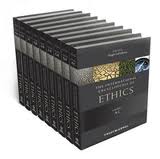
Wow! 9 Volume Ethics Encyclopedia finally out!

You can't but help think 'wow' when you actually hold the 9 beautiful volumes comprising the Wiley-Blackwell International Encyclopedia of Ethics in your hands. It simply is an amazing feat accomplished by an experienced hand at producing top-quality edited works, Hugh LaFollette. So, to get the disclaimers out of the way, I have three entries in this encyclopedia. I also edit journals for this publisher and I am contracted to produce a couple of books for Wiley-Blackwell.

Conflict of interest or no, you can't help but feel in awe of this reference work. The list of authors truly reads like a list of the Who is Who in academic ethics, ranging from David Archard, Marcia Baron, Roger Crisp, Norman Daniels over Dale Jamieson, Margaret Moore and Rosalind Hoursthouse to the likes of Philip Pettit, C. L. Ten, Rosemarie Tong and Michael Tooley and hundreds of others. It is not the case, by the way, that authors could just send their stuff in and after a cursory review they'd be accepted. I truly battled it out over one entry with Hugh and kind of lost, at last any consequentialist would see it that way. When I refused to add particular content that Hugh wanted referenced and that I genuinely thought wasn't worth citing, we found a way out of this impasse (classic stand-off between editor and author, I've been there on both sides more often than I care to remember).  A co-author was added, said co-author added the content Hugh was keen on, and everyone moved on with their lives. As I said, consequentialists would rightly note that I 'lost' this one.

As you would expect of such a work, it provides a comprehensive index both organized in alphabetical order as well as broader subject areas, as well as further readings following each entry. There is even a limited number of entries on 'Non-Western Ethics', the emphasis here being on limited. I was a bit surprised that no dedicated entries were to be found on secular approaches to ethics and their relationship to religious approaches to ethics. I should not pretend, of course, that I read all or even most of the entries, but at least the available indices didn't point me to anything dedicated to this complicated issue. There are a few entries on religion, but nothing on atheism, secularism or indeed humanism. To be fair, many entirely secular approaches to ethics (eg utilitarianism) are featuring prominently in the encyclopedia, so perhaps this isn't such a big deal after all. In any case, it's all too easy, with a work of this scope, to squibble over 'missing' content, or individual authors' take on a particular issue. Only small-minded reviewers would ponder for too long on such omissions or individual authors' takes on particular subject matters.

Researchers and students in my own field of specialization, Bioethics, will find as contributors the names of many leading academics as well as those of many junior scholars. Hugh LaFollette and his team deserve the highest praise for this astounding product. I have no doubt that this encyclopedia will serve as the reference work both for established researchers as well as for students trying to get a quick overview of particular subjects for many years to come.

Of course, this is the 21st century, so the first hint that this project had come to fruition and that my entries were 'around' came with a google scholar alert telling me that something with my name on it had been published. The link embedded in said alert sent me straight to Wiley's website where an on-line version of the entry was available for download. That's a wonderful thing, of course, and something other encyclopedias offer, too. Wiley plans to up-date the individual on-line entries more frequently than it plans to publish future editions of the print copy. I must say that I am a tad bit puzzled about this. To me this seems to suggest that there could (well, that there will) be distinctly different entries on the same subject matter in the same encyclopedia, except that one will be in the print version, and another in the on-line version. In some ways this won't matter, because you can still choose which one to cite for your purposes. On the other hand, once the first set of revisions is filtering thru into the on-line version, there will be different products out there, under the same name. I'm not too keen on this, but I cannot see how this can be avoided. On the bright sight, as authors we will be able to boycott revisions of our on-line content if the publisher behaves sufficiently badly as to draw the wrath of the academic community on itself (just ask Elsevier). I, for instance, have not updated various entries in two Elsevier owned encyclopedias since the academic boycott of Elsevier got off the ground. It goes without saying that at that point in time things would get even more confusing as the print edition would have an entry from one author, while the on-line edition could well have an entry on the same topic from someone different. It'll be fun to watch how Wiley and its team of editors will deal with such an eventuality.

Monday, February 11, 2013

Korean edition of 50 Voices of Disbelief


And here it is, the cover page of the Korean edition of 50 Voices of Disbelief, it's coming in at a whopping 550 pages, no less. After the Polish edition of the volume, this is the second foreign language edition, it'll soon be followed by a Spanish translation. I am pleased to report that the Polish rights for our up-coming 50 Great Myths about Atheism (Wiley-Blackwell 2013) have been sold already. Fingers crossed there will be more international editions of that work!

Friday, February 01, 2013

Enhancement Horror in Germany? Not Quite.

Pharmacology reports in its current issue the results of a survey of about 2600 German university students. The study's objective was to find out to what extent German students use cognitive-enhancing drugs. Turns out, German students find themselves in good company. A survey [doi:10.1038/452674a] of readers of Nature reported that about 20% of readers of that journal take performance enhancing drugs. German students come in at roughly that level. Compare that to office workers (5%). Makes you wonder whether the scientist readers of Nature know something that the rest of us don't know - after all, one reason for people arguing against the use of cognitive-enhancing drugs is that 'we dunno whether they actually work.' It seems those in the know are voting with their feet on this little detail. 

The survey (anonymous as it was) was cristal clear with regard to what it was that they were after. Here's their definition of brain doping, as they call it, 'Substances for brain doping are pharmaceuticals or illegal drugs that you cannot buy in a drugstore and that were not prescribed to you to treat a disease. The only reason why you use this substance is to improve cognitive performance, such as attention, alertness, and mood. Examples are stimulant drugs (amphetamines), caffeine tablets, cocaine, methylphenidate, and mephedrone.' That excluded then academia's traditional brain doping means, caffeine from the coffee maker, those revolting energy drinks and other above-the-counter stuff like that. It also excluded students who would be taking ADHD medication because of a clinical condition they were suffering from. One oddity perhaps, caffeine tables were included in their list, because they're only available in limited quantities in pharmacies in Germany, while here in Northamerica we can, of course, get em at the local 7/11. Of course, the articles also offers standard ruminations about caffein tablets being 'may be' gateway drugs. Bit like the good ol marijuana wars. Oh, did I mention that this research was partially funded by the World Anti-Doping Agency? So, naturally it's all really terrible. Really!

The survey team had a very high response rate (German students, ha!), 2834 surveys were distributed, 2569 were returned. That's a >90% rate of return. The sex distribution was roughly 60% female to 40% male. Here's what the survey unearthed with regard to illicit drug taking for the purpose of cognition enhancement. Of all students about 23% took such drugs. By field of study it looks like this:

  • Economics or law  25.0%
  • Languages or education 17.6%
  • Culture sciences 27.8%
  • Sports science 31.6%
  • Medicine, psychology,
  • or natural sciences 23.9%

By sex it looks like this:

  • Female 20.4%
  • Male 27.9%

In terms of semester distribution, it seems first semester students are the most likely takers. 

First 28.6%
Other 20.0% 

The main conclusion of the study: 'Drug prevention models need to be established.' Amen to that! - Just kidding. Presumably the same drug prevention models that have been such overwhelming failures on all other fronts are being recycled here. 

Like many other bioethicists I am - in principle - in favour of permitting students (and others) to take cognition enhancing drugs, provided certain conditions of voluntariness are met, and provided the students are informed about the known risks and benefits. However, there are drugs and drugs, of course. Some cognition enhancing medicines are addictive, others are not. I would be worried about folks taking addictive enhancing drugs, because I have some doubts about the cost-benefit ratio here. However, in case of cognition enhancing drugs that have no significant harmful side-effects and that are not addictive, it is arguably time to change regulations prohibiting the use of such drugs. Just going by the numbers cited above, it is clear that draconian measures are bound to fail, just like any drugs related prohibition has failed. It is equally clear that many medical professionals are happily prescribing cognition enhancing drugs to their 'patients', given that this is currently the only legal way of obtaining them. Assuming that their 'patients' quality of life improves as a result of their willingness to prescribe these drugs, all the - ethical - power to them. Universities also need to decide how to handle this. One would really want to see research testing whether those students who take such drugs actually perform better (I suspect they would), and whether that is a result of their drug taking. If it turned out to be the case that they had an advantage over students not taking such drugs, there would have to be institutional responses ensuring a kind of a level playing field in terms of exams, grades and such matters. 

Ps: cannot vouch for the veracity of the image used in the top left-hand corner... :).

Tuesday, January 29, 2013

Royal Society Report on End-of-Life Issues makes it into Oxford UP textbook

How delightful little surprises such as this can be :). Talking about the wonders of social networking. So here it goes. Samantha Brennan and Charles Weijer (two friends and colleagues at Western University) posted a link on Facebook, advertising their new bioethics textbook. It's called Bioethics in Canada and found no less a publisher than Oxford University Press. The author list certainly reads like a list of the Who is Who in Bioethics internationally and in Canada. Imagine my delight when I discovered - by chance! - that our Royal Society of Canada Report on End-of-Life Decision-Making was reprinted in part in said textbook. Thank you!

Open Access a threat to academic freedom?

It is no secret to people following my academic writings or this blog for that matter: I am no great fan of Open Access. Its low barriers to market entry have led to a proliferation of dodgy OA outfits that by now easily outnumber the decent OA publishers, and there is no end in sight.  Beall's List of Predatory Publishers flags the magnitude of the problem at hand. Budding academics and those not quite competitive enough to actually get published in decent journals fall prey to their money making schemes in breathtaking numbers. There's more to be said about the business as well as academic flaws of current OA business models, but that isn't the topic of this blog entry.

Recently humanities scholars have woken up to the threat that OA causes to their academic freedom to publish, or so they claim. At the heart of their complaint is this: A whole bunch of research funders insist that the research they fund must be published in an OA journal. Several problems with this: It is probably fair to say that there are only a handful - if that many - decent OA humanities journals out there, and they likely are not in medieval history. If scholars in those disciplines whose work is publicly funded were forced to publish in whatever OA 'journal' (aka webserver) exists in their discipline they would effectively be forced to publish in a location where - really - they would not want to be seen dead. Subscription based journals - often needed to fund academic society activities, something conveniently forgotten in the rush to the economic bottom pit that is OA - would see their submission base diminished as funded academics would no longer be able to choose them as their preferred outlets.

Truth be told, most humanities published research these days isn't funded research to begin with. This is the reason why OA hasn't taken off in our neck of the woods. However, many of us are working in public universities, our salaries are fully or partially funded by taxpayer $$. Forcing us to submit to OA outlets the moment we get our hands on the meagre research funds that are out there for us, would have detrimental consequences for our ability to communicate our findings to colleagues, because they would have to look for our work in the dodgiest of places. It would likely have a deleterious effect on the places (specialist journals with often low circulation) where we discuss and advance our research. It would also likely destroy the viability of some academic societies. Subscription based journal publisher now frequently offer OA options, proposing fairly high fees (>3000$ isn't unusual) to those with spare cash. I must say that I like this idea a lot, because it keeps established loci of academic conversations alive and kicking. I am not so sure what this means in the long-term for the viability of their subscription business model though. Say, if you would make 50% of content in a given volume OA, why should any librarian continue paying the full subscription fee for a journal that's available half-way to anyone who isn't a subscriber. There are undoubtedly challenges ahead, suffice it to say though that I like these latter developments both as an author as an editor.

Some universities have begun to offer funding to humanities researchers who have no external research funding but want to submit to OA publications. Obviously this is only sustainable if dramatic cut-backs at the subscription journals front happen, or if you work for a bank (Harvard, Princeton, Oxbride, etc). Humanities scholars are well-advised to monitor carefully what's happening in their research publishing domains as governments and research funders have decided to revolutionise the way we communicate our research fundings to each other, whether we like it or not. I do think there's a potential threat to our academic freedom to publish in a location of our choosing, but it doesn't seem to be as dramatic as some academics make it to be. After all, there ARE other ways to communicate your work to the world and your colleagues, for instance via social networking, blogging, repositories such as SSRN, academia.edu, university based OA repositories and so on and so forth. Of course, should you need an actual academic job, you'll find that these sorts of outlets are not going to get you one... Incidentally, at least for the humanities this is true also for pretty much any OA (online only) publication you chose to go for.

Post scriptum: As an aside, it seems university libraries have been at the forefront of pushing for OA. Makes one wonder, in time of diminishing library funds, whether that's a classic example of having your cake and eating it. Be that as it may, it turns out, the same libraries have also been busy robbing students of their copyright to their own research theses stored on library servers. Remakable times!


Monday, January 28, 2013

Taxing junk food?

Nice story on the BBC World website. Leading UK medical bodies, among them the Royal College of Paediatrics and Child Health, propose that soft drinks should be hit with a special tax (about 20p per litre). The objective, obviously, is to reduce demand for such products. Why would one want to reduce demand for such products? Mostly because they can be linked to the obesity epidemic in the country. According to the BBC report, 'one in four adults is classified as obese and one in three children is already obese or overweight before they finish primary school.' 

Basically these experts propose to treat soft drinks pretty much like smoking and alcohol are being treated in taxation term. The argument is that consumption of such junk food leads predictably to an increase in obesity and a whole range of known, and expensive to treat, illnesses caused by obesity. Reducing obesity would overall result in an increase in individual (and aggregative societal) well-being and longevity. These are clearly all desirable goals.  

To make things look good, their proposal also includes suggestions such as how government should spend the extra tax dollars (well, Pounds). It is proposed that government spends it on subsidies for fruit and school meal improvements in general. Great idea, considering that school meals in many school in that country qualify at best as junk food. 

There is no great risk that the current Conservative/Liberal UK government will run with this proposal. It has been busy trying to get industry to volunteer improvements on the soft drink frontiers. Industry folks claim that the addition of sugar to soft drinks has already decreased significantly. Well, assuming that that is true, I guess soft drinks that ain't directly linked to obesity could be exempted. I don't know, of course, whether there might be other problems with soft drinks beyond the sugar, indeed, I don't even know whether the industry guy who points out that 61% of soft drinks contain no added sugar tells the truth. He also points out that the consumption of soft drinks containing added sugar has fallen while obesity has increased anyway. If he's right, one can't help but think of other worthy targets for higher taxes.

I am not opposed to punitive tax rates on demonstrably unhealthy food products...but, the moment you look at this sentence, you can't help but wonder where this will end? Glasgow's fried Mars bars anyone? Fries with mayonaise anyone? Cake? The list of crap we eat and enjoy is pretty endless. FWIW, I recently had a fried Mars bar, because I wanted to know how this ur-Scottish culinary delight tastes. Well, it's gross. Tax it to the hilt as far as I care. Just kidding :). 

There's a serious point to this though: it seems to me that if one wanted to do this truly fairly one would have to balance the quality-of-life benefits folks derive from gobbling down junk food of any kind against the societal quality-of-life costs. People don't enjoy junk food only because they live in food deserts, or because they're poor and can't help it/don't know better (add your favourite assumption/prejudice about the kinds of people that eat junk food), etc. Many folks enjoy junk food because they enjoy the taste of it. Being a proper continental European I love my fries with mayo. We know our lifestyle choices ain't particularly healthy, and we don't care in the end. Health is only one value among many that make life worth living. It is a very important value, but it isn't uncontroversially on top of anyone's hierarchy of values. So, taking pleasure out of our lives (or making our pleasures more expensive by means of tax policies) requires sound justifications that go beyond pointing to health consequences. 

It seems to me that such taxes can probably be justified - and they might ultimately be a good idea. It should be interesting to see whether this experiment would result in the desirable health outcomes its proponents are hoping for. However, in a just society there should then be equal taxation for other products that are equally detrimental to our health. Guess one could quantify what kinds of damages what kinds of products cause and tax (or insure) accordingly. That is, provided the choices those make who indulge are reasonably their own and not choices determined by forces beyond their control (eg food deserts). 

Anyhow, guess I am just thinking aloud here. One worry I have is clearly to do with the question of where this will end. But then, in philosophy we know that slippery-slope arguments are typically terrible, unsustainable arguments, so I suspect reasonable, definsible lines can probably be drawn in the sand. How and where would you draw them? 


Sunday, January 27, 2013

'Discrimination' - always a wrong?

I recall teaching in South Africa, in this case a large class of medical students (likely 300+ were in the lecture theatre). For some reason or other that I do not recall a student replied in response to a particular scenario (I think it was a resource allocation justice case study) that that would be discriminatory, implying that that in its own right would make it a wrong.

Indeed, in common language usage people often wield the discrimination flag when they think they have been wronged in an unfair way. Gay people in Russia claim that they are discriminated against, and that therefore they have been wronged. Some religious people claim discrimination in various contexts, for instance when they are asked to do certain things that their profession requires of them as professionals. They consider this form of religious discrimination wrong. British readers will see these sorts of claims frequently pop up in reporting of the Daily Telegraph.

What people tend to miss is that discrimination simply describes that someone is making choices for or against something. Say, I choose coffee over other beverages in the morning, that means I discriminate against those other beverages. Or I choose to fly in the front of the bus if I can afford to avoid the back of the bus, certainly on all flights longer than, say 5 hours or so. I discriminate against the cramped seating conditions in the back of the bus.

Discrimination is about making choices between options, it is about drawing distinctions.

Now, it seems to me that someone just claiming 'discrimination' is begging the question then. What question? The question of whether or not a particular discriminatory act is justifiable or not. Many people claiming 'discrimination' tend to beg this question. Think of discrimination based on ethnicity. Is it always wrong? If so, most affirmative action programs in operation today would then be wrong, too. Perhaps we should try, in our common usage of the term, to distinguish between 'just discrimination' and 'unjust discrimination'. 'Discrimination' claims without the qualifier should probably be ignored because it is unclear wether there is a problem to begin with. They constitute mere handwaving in the public sphere kind of activities. Once someone claims 'unjust discrimination' we should ask for a justification of the 'unjust' claim. It certainly is not the case, that 'Discrimination of any kind is wrong.'

Simple enough, isn't it?

Wednesday, January 16, 2013

Quebec at the forefront of assisted dying effort in Canada

Exciting developments in Quebec. There is a cross-party consensus in the provincial parliament that assisted dying ought to be available to certain patients, namely those who are on palliative care, who suffer from a terminal illness and who consider their lives not worth living any longer. There is currently contradictory information in the media-reporting about whether assisted dying extends all the way to voluntary euthanasia or just assisted suicide. What seems clear is that the legislators avoid - likely for legal reasons - from calling what they proposing what it is. 

I have not been able to get my hands on an English version of what is reportedly a 400pp legal document indicating that Quebec is on firm legal grounds, constitutionally, if it decided to go ahead with this plan.

Here is how the Huffington Post has reported the gist of it: 

'Under the recommendations, patients themselves would have to make the request to a doctor on the basis of unbearable physical or psychological suffering. Two physicians would have to approve the request, which would have to be made in writing.
Doctors would not face criminal charges in these circumstances, the report said. Any law should state that the refusal, interruption, abstention from care or the application of a terminal sedative in those circumstances could not be considered a suicide.
The Quebec panel, which was headed by lawyer Jean-Pierre Menard, said people suffering from an incurable or degenerative illness should be allowed to ask for medical assistance to help them die.'

Ethical Progress on the Abortion Care Frontiers on the African Continent

The Supreme Court of the United States of America has overridden 50 years of legal precedent and reversed constitutional protections [i] fo...